


Math
Mar 22, 2026
Calculus I
Calculus II
Calculus III
Linear Algebra
Ordinary Differential Equations
Real Analysis
Why Math Models Keep Nailing March Madness Upsets—and Why the Best Bracket Strategy Still Isn’t Picking the Most Likely Winners
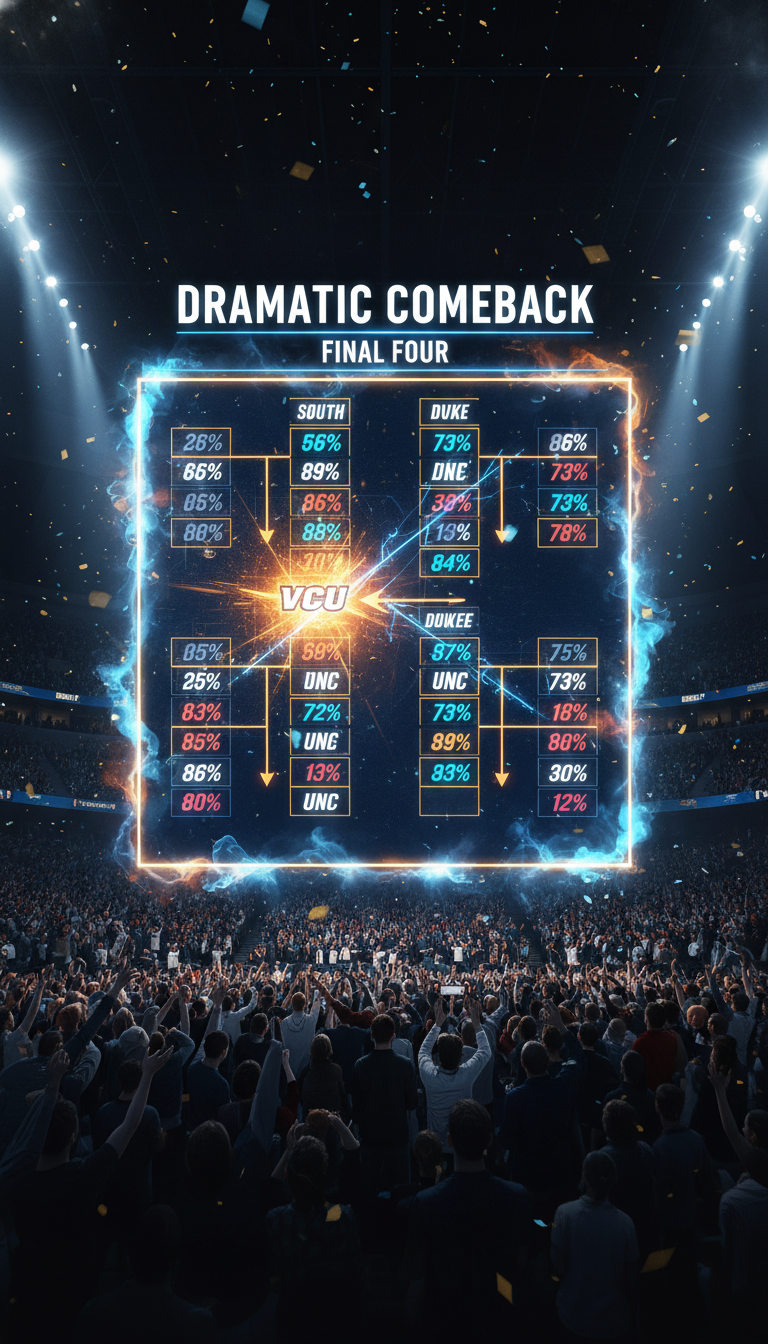
Math-based March Madness brackets are trending after Tim Chartier’s model flagged VCU’s upset over North Carolina and projected an all-No. 1-seed Final Four. Here’s how these model
March Madness looks like pure chaos, but the deeper story is that the chaos has structure. That is why math models can sometimes spot an upset like VCU over North Carolina before it happens, yet still leave millions of brackets in ruins. The real question is not whether math can predict the tournament perfectly. It is what math is actually good at, and how that differs from the strategy that wins a bracket pool.
What these bracket models are really doing
Models like Tim Chartier’s, SportsLine’s simulations, and fan-built Monte Carlo brackets do not “see the future.” They combine team strength estimates with repeated game simulations. Usually that starts with ratings built from efficiency margins, strength of schedule, scoring profiles, injuries, and matchup-sensitive factors like tempo or rebounding.
Then the model simulates the tournament thousands or even millions of times. If Team A beats Team B in 68% of simulations, that does not mean Team A is guaranteed to win. It means the upset still happens often enough to matter. That is how a model can correctly flag a game like VCU over UNC: not because it knows the exact comeback script, but because it identifies a live underdog more often than the public expects.
Explore our free math courses

Calculus I
University · Mathematics
Calculus II
University · Mathematics

Calculus III
University · Mathematics

Linear Algebra
University · Mathematics

Ordinary Differential Equations
University · Mathematics

Real Analysis
University · Mathematics
How a model can catch “madness” better than intuition
The biggest misconception is that math models fail because the tournament is unpredictable. In reality, they often outperform gut picks precisely because they treat uncertainty honestly. Human brackets tend to overreact to brand names, seed numbers, and recent narratives. Models ask a colder question: how often does this underdog win if we replay the matchup over and over?
That matters in games where the seed line hides the real gap. Transfer portal turnover, uneven nonconference schedules, and late-season improvement can make a No. 11 seed much stronger than casual fans assume. A model can absorb those signals through possession-level data and opponent-adjusted ratings, even when the bracket label says “upset.”
That also explains why an all-No. 1-seed Final Four can be mathematically plausible in one year and not in another. “Chalk” is not anti-math. If the top teams are genuinely stronger than the field, the simulations will show it.

Why the most likely bracket is usually not the best pool strategy
Here is the key distinction: the most likely bracket and the highest-expected-value bracket for your pool are often different.
If you are trying to predict the real tournament as accurately as possible, you should usually lean toward favorites. But if you are trying to win a pool, you are competing against other entries, not against reality alone. That changes the math.
- If everyone in your pool picks Duke to win, choosing Duke gives you little separation.
- If a slightly less likely champion is being underpicked, that choice may have higher strategic value.
- The larger the pool, the more useful it can be to accept some extra variance.
So no, filling out the “most probable” bracket does not automatically maximize your chance to finish first. Pool optimization requires balancing two probabilities at once: the chance your picks are right, and the chance your rivals made the same picks.
Why a perfect bracket is still basically out of reach
Even advanced models do not come close to making a perfect bracket realistic. The often-cited odds, around 1 in 9.2 quintillion under strong assumptions, reflect how many independent things must go right in sequence. Better models improve your probabilities at the margins, but the tournament still contains too many coin-flip-like branches.
More simulations do not solve that. Running 10,000 or 10 million simulations helps estimate probabilities more precisely, but it does not remove the underlying randomness. A model can become better calibrated without becoming omniscient.
The real power of simulations is not perfection. It is ranking possibilities better than intuition does.
Which metrics matter most for deep runs?
The best forecasting systems usually rely on efficiency-based measures rather than raw win-loss record. Metrics in the KenPom/BPI family tend to matter because they estimate how strong a team actually is on a per-possession basis, adjusted for opponent quality. For deep runs, models often care especially about:
- offensive and defensive efficiency balance
- 3-point dependence versus shot-quality consistency
- turnover rate and defensive rebounding
- how a team performs away from home
- lineup stability, injuries, and late-season form
In the transfer-portal era, this last category matters more than ever. Teams can change dramatically within one season, which means models that update quickly and weight recent performance intelligently may do better than systems that rely too heavily on preseason assumptions.

What to take from this year’s predictions
If Chartier’s all-No. 1 Final Four holds, it will not mean the tournament has become boring. It will mean the top teams were correctly rated as dominant. If another VCU-style shocker lands, that also will not discredit the math. It may confirm that the model assigned meaningful upset probability before the public caught on.
The deeper lesson is simple: math does not eliminate March Madness. It explains which parts are signal, which parts are noise, and why the smartest bracket depends on whether you want to be accurate or actually win your pool.