


Math
Mar 21, 2026
Calculus I
Calculus II
Calculus III
Linear Algebra
Ordinary Differential Equations
Real Analysis
140 Million Barrels Sounds Huge. The Math Says: It Depends on the Denominator
A temporary US waiver for 140 million barrels of Iranian oil sounds massive, but its real significance depends on what you compare it to. Here’s the oil math behind the headline, a
When a headline says the US may allow the sale of 140 million barrels of Iranian oil, the number feels staggering. But big numbers are often bad at telling the truth by themselves. The deeper layer is this: in markets, scale only makes sense relative to a rate. And in oil, that usually means one question: supply for how long?
That is why the same 140 million barrels can sound like a market-saving flood in one sentence and a barely noticeable blip in the next. The math is not contradictory. It is all about the denominator.

The headline number versus the useful number
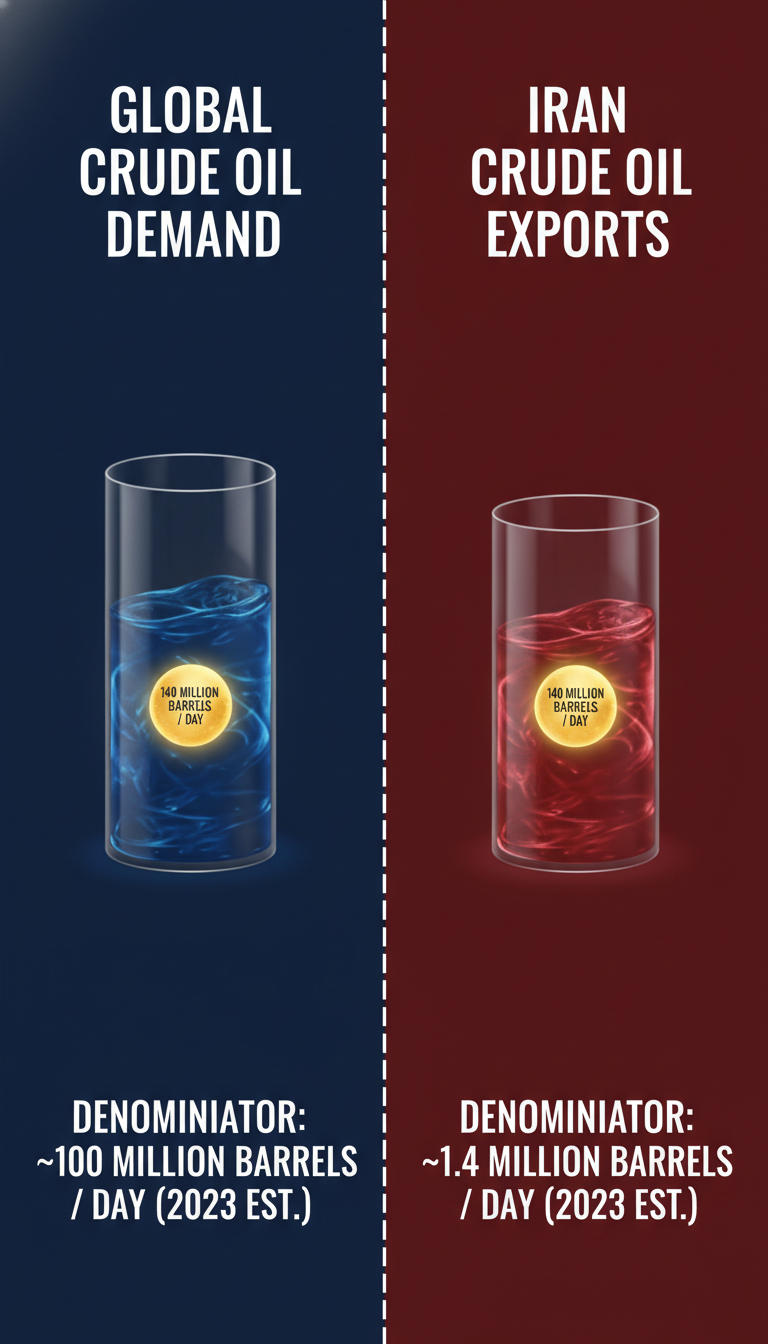
The basic comparison is straightforward. The world consumes roughly 100 million barrels of oil per day. If you divide 140 million by 100 million, you get about 1.4 days of global consumption. Rounded, that is about a day and a half.
That instantly changes the emotional feel of the story. A number that sounded almost limitless becomes a short-lived cushion. It may help calm a sudden panic, but it does not solve a prolonged disruption.
This is a classic math lesson hiding inside a geopolitical story: totals matter less than totals divided by time.
Explore our free math courses

Calculus I
University · Mathematics

Calculus II
University · Mathematics

Calculus III
University · Mathematics

Linear Algebra
University · Mathematics

Ordinary Differential Equations
University · Mathematics

Real Analysis
University · Mathematics
Why oil markets care more about flow than stock
The video points to an important idea: markets care about flow, not just piles. Here is the fuller version. Oil prices are set not only by how much oil exists, but by how quickly it can be delivered, refined, insured, shipped, and turned into usable fuel.
So even if 140 million barrels are already on tankers, that does not mean all 140 million hit the market at once. Release rates matter. Port capacity matters. Refinery compatibility matters. Buyer willingness matters. A stored stockpile is not the same thing as a smooth daily stream.
This is also why traders react strongly to threats around chokepoints like the Strait of Hormuz. A disruption there is not just about lost barrels in theory. It is about interrupted timing. And timing is what creates price spikes.
The same oil looks huge on Iran’s scale
Now switch denominators. Iran’s exports are often discussed in the range of 1 to 2 million barrels per day. Against that baseline, 140 million barrels is much larger: roughly 70 to 140 days of exports, or about two to four months depending on the rate used.
So both claims can be true at once:
- Small relative to total world demand
- Large relative to Iran’s own export flow
That is not spin. It is ratio logic. The same numerator can tell very different stories depending on the comparison set.
A concrete example of why this still matters
Suppose markets fear a short disruption of 2 million barrels per day for two weeks. That would amount to 28 million barrels of missing supply. In that scenario, access to 140 million barrels looks powerful: it could more than cover that temporary gap on paper.
But imagine instead a broader, longer disruption affecting several million barrels per day for months. Then 140 million barrels starts to look more like a bridge than a fix. It buys time. It does not rewrite the underlying supply picture.
This is the part short clips often skip: the impact of a stockpile depends on the size and duration of the shock it is offsetting.
A common misunderstanding: barrels are not dollars, and not all barrels are equal
Another easy mistake is to jump from volume to value too quickly. At $100 per barrel, 140 million barrels implies around $14 billion in gross value. But gross value is not the same as immediate revenue, and revenue is not the same as strategic power. Discounts, transport costs, payment channels, and political constraints all affect what that oil is actually worth in practice.
There is also an edge case many people miss: not every refinery can process every crude equally well. Oil differs by sulfur content and density. So a released barrel is not always a perfect substitute for any missing barrel elsewhere.

The real math lesson behind the story
This trend is really about perspective. Raw numbers trigger emotion, but ratios explain reality. In oil markets, every supply headline secretly contains a clock. The question is never just, “How much oil?” It is, “How much oil relative to demand, and for how long?”
Once you ask that, the story becomes clearer. 140 million barrels is big enough to matter in a short squeeze, small enough to vanish quickly on a global scale, and a perfect example of why denominators are often the most important numbers in the room.
Big headline numbers grab attention. The math underneath tells you whether they change the world, or just buy it a little time.