

Geology
Mar 19, 2026
Geochemistry
Geophysics
Historical Geology
Mineralogy
Petrology
Physical Geology
Why Devils Tower Sways: The Surprising Seismic Rhythm Hidden Inside Wyoming’s Icon
A new seismic study shows Devils Tower is not perfectly still at all. It gently sways and twists in response to Earth’s constant background vibrations, revealing how shape, fractur
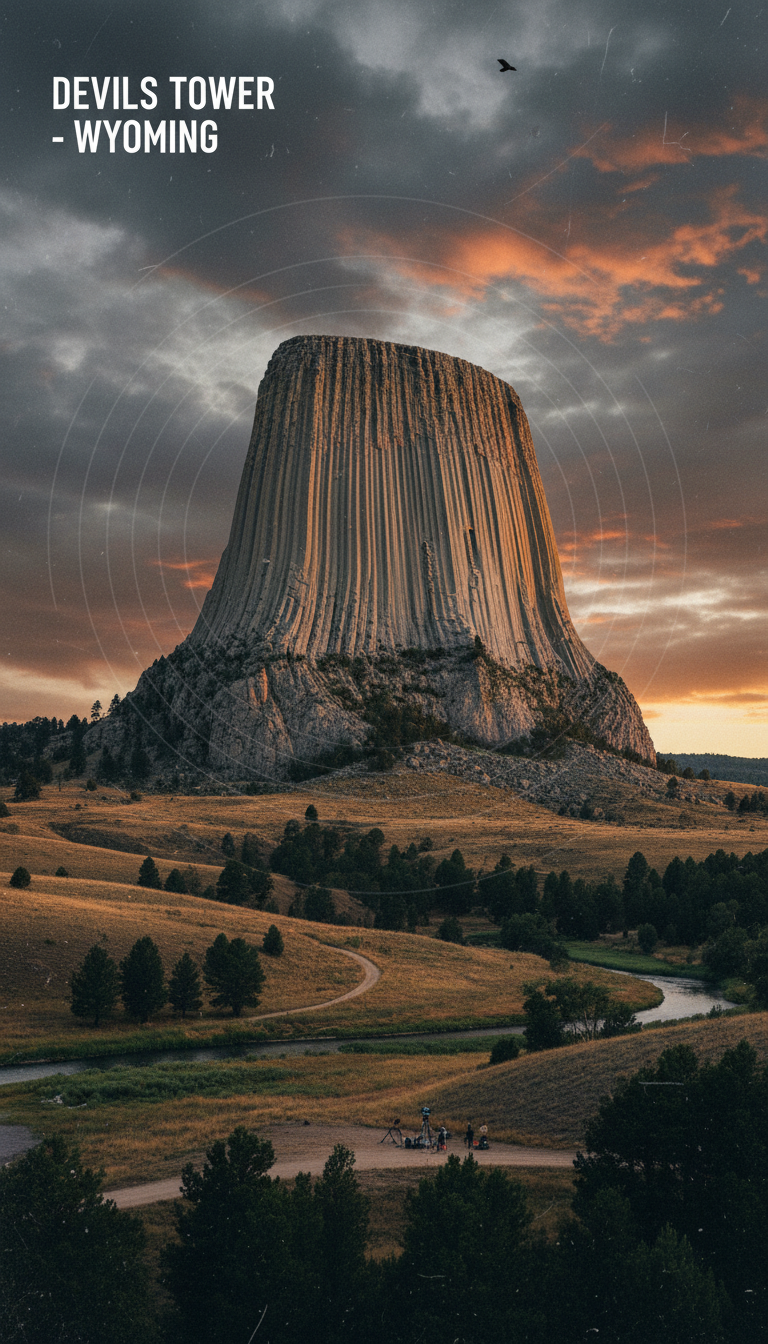
Devils Tower looks like the kind of landform that should be immovable: a massive stone column rising above the Wyoming landscape with almost architectural symmetry. But the deeper story behind the viral headlines is even better than “the tower sways.” Scientists have shown that Devils Tower behaves like a natural resonant structure, and that tiny motion reveals something important about how big rock masses actually work.
In other words, this is not just a fun fact. It is a window into the mechanics of fractured rock, the influence of shape on motion, and the way geologists can read a landscape by listening to vibrations too small for humans to feel.
What researchers actually found
In 2024, scientists placed sensitive broadband seismometers on the summit, at the base, and at a reference site nearby. Instead of waiting for an earthquake, they recorded ordinary ambient vibrations: wind, distant ocean-generated microseisms, and the planet’s constant low-level background shaking.
The results showed three main resonance modes. The first two occur at about 1.1 and 1.2 hertz, meaning the tower’s dominant sway is roughly once per second in two nearly perpendicular directions. A third mode appears near 2.1 hertz and involves torsion, a slight twisting around the vertical axis.
That close pairing of the first two modes is not random. Devils Tower is unusually symmetrical for a natural rock mass, so it can rock east-west and north-south in almost the same way.
Explore our free geology courses
Geochemistry: Principles and Applications
Free course

Geophysics Fundamentals and Applications
Free course

Historical Geology: Earth's Past Through Time
Free course

Introduction to Mineralogy
Free course
Petrology: Igneous, Sedimentary, and Metamorphic Rocks
Free course
Physical Geology
Free course
Why resonance matters more than “movement”
The short-video version compares Devils Tower to a tuning fork, and that is a useful image. But the deeper mechanism is that every structure has preferred ways of vibrating, called normal modes. If background energy contains those frequencies, even weak forcing can keep the structure gently moving.
This does not mean the tower is wobbling dramatically. The motion is tiny and imperceptible. The important point is that resonance acts like a fingerprint of stiffness, geometry, and internal structure. Engineers use this logic on bridges and skyscrapers; geologists can use it on cliffs, spires, and rock towers.
The most surprising finding: the tower is much less stiff than intact rock
One of the most interesting results is that the tower’s effective Young’s modulus was modeled at about 8 gigapascals. Intact phonolite is far stiffer, around 55 gigapascals. That big gap tells us Devils Tower does not behave like one flawless block.
The reason is its famous columnar jointing. Those long fractures between columns can flex, open slightly, and compress under stress. Even tiny crack compliance changes the behavior of the whole rock mass. This is a common misunderstanding in geology: people often assume composition alone controls strength and motion. In reality, fractures can matter just as much as mineral makeup.
A useful analogy is a stack of tightly packed books versus a solid wooden block. The books may look like one object from a distance, but they deform differently because of the surfaces between them.

What this means for hazards and landscape evolution
This kind of analysis has practical value. If geologists know a tower’s natural frequencies and mode shapes, they can better estimate how it might respond to stronger shaking from earthquakes, intense winds, or progressive crack growth over time.
- Resonance can amplify motion during rare but stronger events.
- Jointed rock masses may weaken in ways that are not obvious from appearance alone.
- Similar methods can help assess rockfall hazards on cliffs, pinnacles, and steep canyon walls.
There is also a broader implication: landscapes are not static sculptures. They are dynamic systems constantly responding to subtle forces. Devils Tower is a dramatic example, but many freestanding rock towers likely have their own “hum.”

What the viral posts usually leave out
Two things often get lost online. First, this study does not support old pseudoscientific claims that Devils Tower is a petrified tree stump. Its geology is well explained as an igneous intrusion of phonolite porphyry later exposed by erosion.
Second, the cultural context matters. Devils Tower is not just a geological curiosity or a national monument. It is also a sacred site for several Native tribes. That makes careful, respectful scientific study especially important.
The bigger lesson from a moving monument
Devils Tower’s tiny sway is fascinating because it turns a familiar landmark into a living mechanical system. The tower’s shape, fractures, and rock properties all combine to produce a measurable rhythm. Once you know that, the monument becomes more than a scenic landmark: it becomes evidence that even the most solid-looking parts of Earth are quietly in motion.
That may be the most awe-inspiring part of the whole story. The tower is not defying solidity. It is revealing how the planet never truly stands still.