

Biology
Mar 21, 2026
Molecular Biology
Genetics
Biochemistry
Cell Biology
Evolutionary Biology
Physiology
Tiny Rocket Engines Inside Malaria Parasites: What They Are and Why They Matter
Researchers found that malaria parasites can propel iron-rich hemozoin crystals by chemically breaking down hydrogen peroxide, creating a rocket-like effect at the nanoscale. Here’
The viral version of this story is irresistible: malaria parasites have “tiny rocket engines.” That image is catchy, but the deeper story is more interesting. The crystals are not miniature machines. They are waste products from blood digestion that appear to move because of a chemical reaction happening on their surfaces—and that motion may solve several life-or-death problems for the parasite at once.
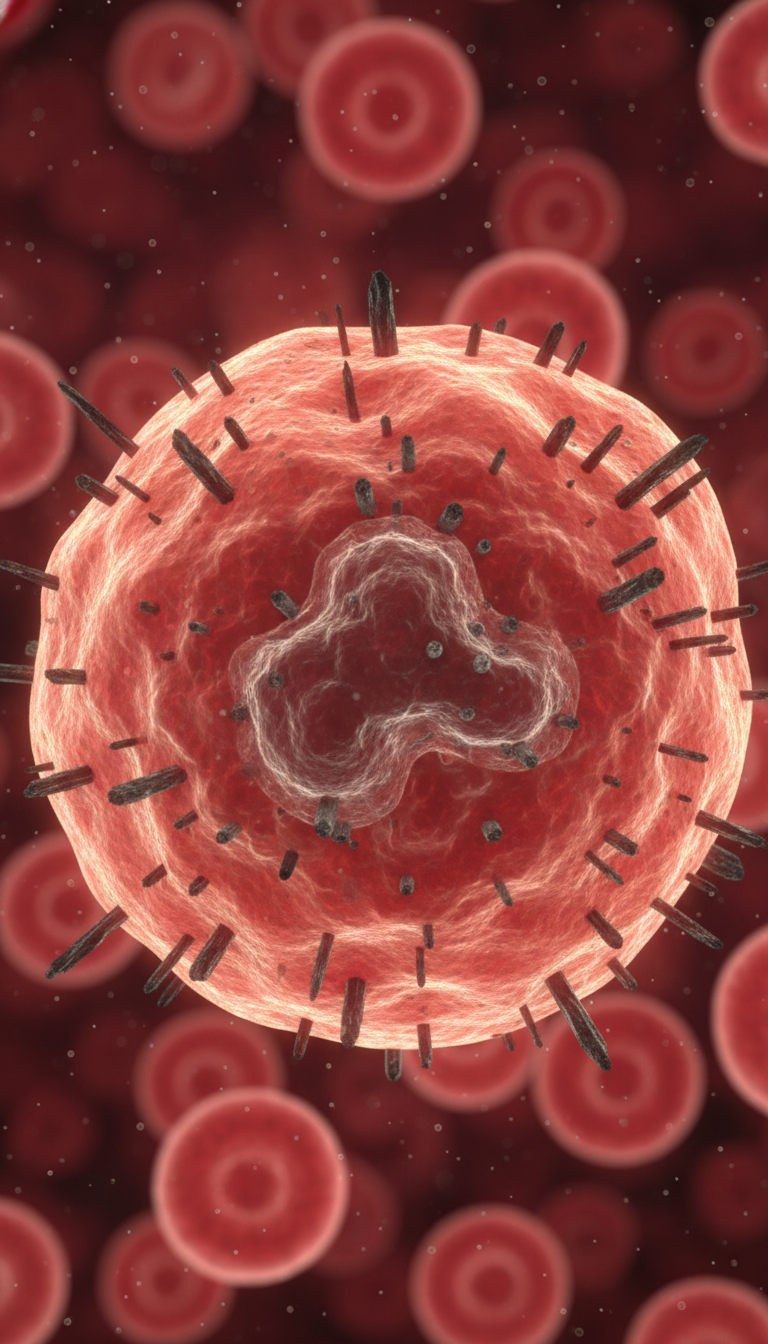
Once you see the mechanism, the discovery becomes more than a fun metaphor. It helps explain a decades-old mystery in parasite biology, reveals a new vulnerability in one of humanity’s deadliest pathogens, and shows that biology can use surprisingly physical tricks at the nanoscale.
What the parasite is actually moving
Plasmodium falciparum, the deadliest malaria parasite, spends part of its life inside human red blood cells. There it digests hemoglobin, the oxygen-carrying protein in blood. That gives the parasite amino acids it needs, but it also releases heme, an iron-containing molecule that is chemically dangerous in excess.
To survive, the parasite converts that toxic heme into inert crystals called hemozoin. Biologists have known about hemozoin for years, and some antimalarial drugs already interfere with this detox system. What puzzled researchers was that these crystals often move rapidly and chaotically inside the parasite, as if something were actively driving them.
How the “rocket” mechanism works
The new finding is that hemozoin motion can be powered by the breakdown of hydrogen peroxide (H2O2), a reactive oxygen-containing molecule produced during metabolism and oxidative stress. On the crystal surface, H2O2 decomposes into water and oxygen. If that reaction happens unevenly across the crystal, it creates tiny local forces that push or spin the particle.
Explore our free biology courses

Molecular Biology
University · Biology

Genetics
University · Biology

Biochemistry
University · Biology
Cell Biology
University · Biology

Evolutionary Biology
University · Biology
Physiology
University · Biology
That is why researchers compare it to rocket propulsion: a chemical reaction generates directional thrust. The similarity is real at the level of physics, even though no literal engine exists. The crystal is more like a self-propelled particle than a machine with parts.
The key point is that the crystal itself is participating in chemistry that changes its motion. In isolated experiments, hemozoin crystals reportedly spun on their own when exposed to H2O2, even outside the full cellular environment. That strongly suggests the motion is not just cargo transport by some other parasite machinery.
Why this motion helps the parasite survive
This is the most important layer beyond the headline. The motion seems useful for at least three reasons:
- Detoxifying hydrogen peroxide: H2O2 can damage proteins, membranes, and other cell components. Breaking it down reduces oxidative stress.
- Preventing crystal clumping: If hemozoin aggregates too much, storage and handling of heme waste may become less efficient.
- Maintaining iron and heme balance: The parasite lives in a chemically dangerous environment full of iron-rich molecules. Controlled crystal behavior may help keep that system stable.
In other words, the motion may not be a weird side effect. It may be part of how the parasite manages toxic byproducts while continuing to feed and grow inside red blood cells.
What evidence makes scientists take this seriously
The strongest evidence is that the motion tracks the chemistry. Researchers found that crystal movement stops when the parasite dies, which implies it depends on active parasite conditions rather than random Brownian motion alone. They also observed slower motion in low-oxygen conditions, consistent with reduced H2O2 production and altered reaction dynamics.

Just as important, isolated crystals could still move in the presence of H2O2. That helps answer the first big question: how can a simple crystal move so fast? Because the crystal is not passive debris; it behaves like a chemically active nanoparticle whose surface reaction creates thrust.
This also explains why the phenomenon was easy to miss for decades. Inside a crowded, dynamic parasite cell, chaotic crystal motion could look like noise. Only with the right microscopy, controls, and chemical tests does the pattern become interpretable.
Could this become a malaria treatment?
Possibly—but this is not an instant cure. The second big question is why this could be a drug target without immediately becoming a drug. If parasite survival depends on this crystal-H2O2 interaction, then disrupting it might increase oxidative damage, impair heme detoxification, or cause harmful crystal behavior. That makes the system attractive in principle.
But turning a mechanism into a medicine is hard. Researchers still need to show exactly how much the propulsion contributes to parasite survival in living hosts, whether the target is specific enough to avoid harming human cells, and what molecule could block it safely. Human biology also uses peroxide chemistry, so selectivity matters.
Still, the discovery is exciting because it opens a new category of vulnerability: not just a parasite enzyme or receptor, but a physical-chemical survival strategy.
Why this discovery matters beyond malaria
This may be the first known biological example of self-propelled metallic nanoparticles powered this way. That matters for two reasons. First, it expands what scientists think cells can do using simple chemistry. Second, it may inspire engineered microrobots or drug-delivery particles that use similar reactions in controlled settings.

For now, the real significance is simpler: a long-mysterious behavior inside malaria parasites finally has a plausible mechanism, and that mechanism connects chemistry, motion, and survival in one elegant system.
The “tiny rocket engine” headline is not literally true, but it points to something genuinely remarkable. Hemozoin crystals appear to move because they chemically decompose hydrogen peroxide, generating nanoscale thrust. That motion likely helps the parasite detoxify its environment and manage heme waste—and while it is not yet a cure, it may reveal a new way to fight malaria.