

Geology
Mar 21, 2026
Geochemistry
Geophysics
Historical Geology
Mineralogy
Petrology
Physical Geology
The Great Unconformity May Not Be a Snowball Earth Scar After All
New evidence suggests Earth’s famous missing billion years were carved mainly by ancient tectonic uplift and long weathering during the assembly of the supercontinent Columbia, not
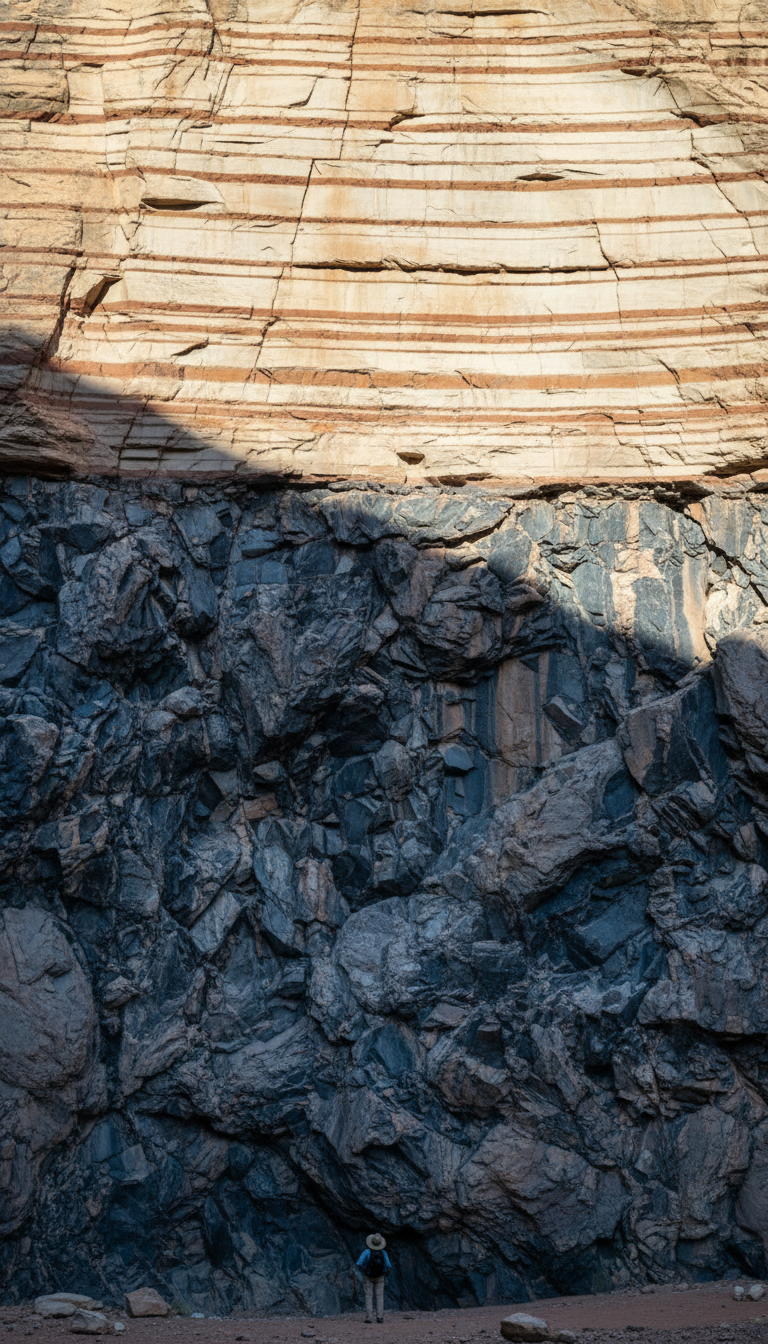
The Great Unconformity is one of geology’s strangest absences: in many places, Cambrian sedimentary rocks sit directly on much older crystalline basement, with hundreds of millions to more than a billion years missing in between. For years, one of the most compelling explanations was dramatic and simple: global Snowball Earth glaciations scraped continents bare. But new work points to a deeper, slower story—one tied to ancient mountain building, crustal uplift, and prolonged weathering long before those ice ages.
What the new explanation says
A 2026 PNAS study focused on the North China craton and found that the main phase of erosion beneath the Great Unconformity happened mostly between about 2.1 and 1.6 billion years ago. That places the biggest crustal stripping during the assembly of the supercontinent Columbia, not during the Cryogenian Snowball Earth episodes around 720 to 635 million years ago.
The authors argue this was not a single catastrophic shaving-off of the continents. Instead, it was a long, multistage process. Their estimates suggest roughly 12 kilometers of crust were exhumed, with more than 60% of that erosion occurring before 1.6 billion years ago. In other words, the “missing time” may reflect a very old tectonic and weathering history that later surfaces simply inherited.
How rocks can record erosion that old
The key tool is multi-thermochronology, which uses minerals as natural cooling clocks. As rocks rise toward the surface, they cool through specific temperature windows. Different minerals and isotopic systems close at different temperatures, so combining them lets geologists reconstruct when rocks moved from deep, hot crust toward shallower, cooler levels.
Explore our free geology courses
Geochemistry: Principles and Applications
Free course

Geophysics Fundamentals and Applications
Free course
Historical Geology: Earth's Past Through Time
Free course

Introduction to Mineralogy
Free course
Petrology: Igneous, Sedimentary, and Metamorphic Rocks
Free course
Physical Geology
Free course
In this case, the North China rocks appear to have cooled by roughly 370°C from mid-crustal depths near 25 kilometers. That is hard to explain without major exhumation. Just as important, the study reports no strong cooling signal during the Cryogenian that would indicate Snowball Earth was the main erosive event there.
The authors also compare their pattern with signals from other cratons, including Laurentia, Baltica, and Amazonia, and point to geochemical evidence for enhanced weathering in the Paleoproterozoic. Together, that supports a broad tectonic-weathering origin rather than one late global glacial pulse.
Why this challenges the Snowball Earth idea
The Snowball Earth hypothesis was attractive because it linked several big mysteries at once: global glaciation, continent-scale erosion, and perhaps even nutrient delivery before the Cambrian Explosion. But the new model weakens that neat package.
If most erosion happened more than a billion years earlier, then Snowball Earth may have modified an already ancient landscape rather than creating the Great Unconformity from scratch. That does not mean glaciation played no role anywhere. It means the dominant cause may vary by region, and North China may preserve a record where tectonic uplift and long weathering did most of the work.
So why would Columbia assembly erase so much rock?
Because supercontinent assembly is not quiet. When continents collide, they thicken crust, build mountains, and reorganize stress across huge areas. Thickened crust can later uplift and erode for hundreds of millions of years. Exposed highlands also accelerate chemical weathering, especially under long-term subaerial exposure.

That matters because the so-called “Boring Billion” has often been portrayed as tectonically subdued. This study pushes back on that picture. At least in some cratons, the aftermath of Paleoproterozoic tectonics appears to have been powerful enough to shape one of Earth’s most famous stratigraphic gaps.
What remains unresolved
Two big questions are still open.
- How do regional timing differences fit the model? The Great Unconformity is not perfectly synchronous worldwide. Some places, such as parts of Laurentia, may record later erosion or additional overprinting. That means a global explanation probably needs both a shared deep-time framework and regional episodes layered on top.
- What does this mean for the Cambrian Explosion? If the main weathering pulse was Paleoproterozoic, then any nutrient link to Cambrian animal diversification becomes less direct. Scientists now have to ask whether ancient weathering left a long geochemical legacy, or whether later coastal, tectonic, and oceanographic processes mattered more immediately.
The bottom line
The new evidence does not “solve” the Great Unconformity everywhere, but it strongly shifts the center of gravity of the debate. Instead of a single Snowball Earth stripping event, the missing billion years may mostly reflect prolonged tectonic uplift and weathering during Columbia assembly, with later glaciations adding only local or secondary effects. The deeper lesson is that Earth’s biggest gaps in time are often not created by one dramatic moment, but by long chains of processes that only become visible when multiple lines of evidence finally line up.