


History, Politics & World Affairs
Mar 21, 2026
Political Theory I: Classical
Political Theory II: Modern
International Relations
Comparative Politics
Political Theories
Trump’s Iran Pivot: If Regime Change Is Off the Table, What Is the U.S. Actually Trying to Achieve?
Trump’s latest signal on Iran suggests a major shift: away from regime change and toward a narrower goal. Here’s what likely changed, what ‘winding down’ really means, and how the
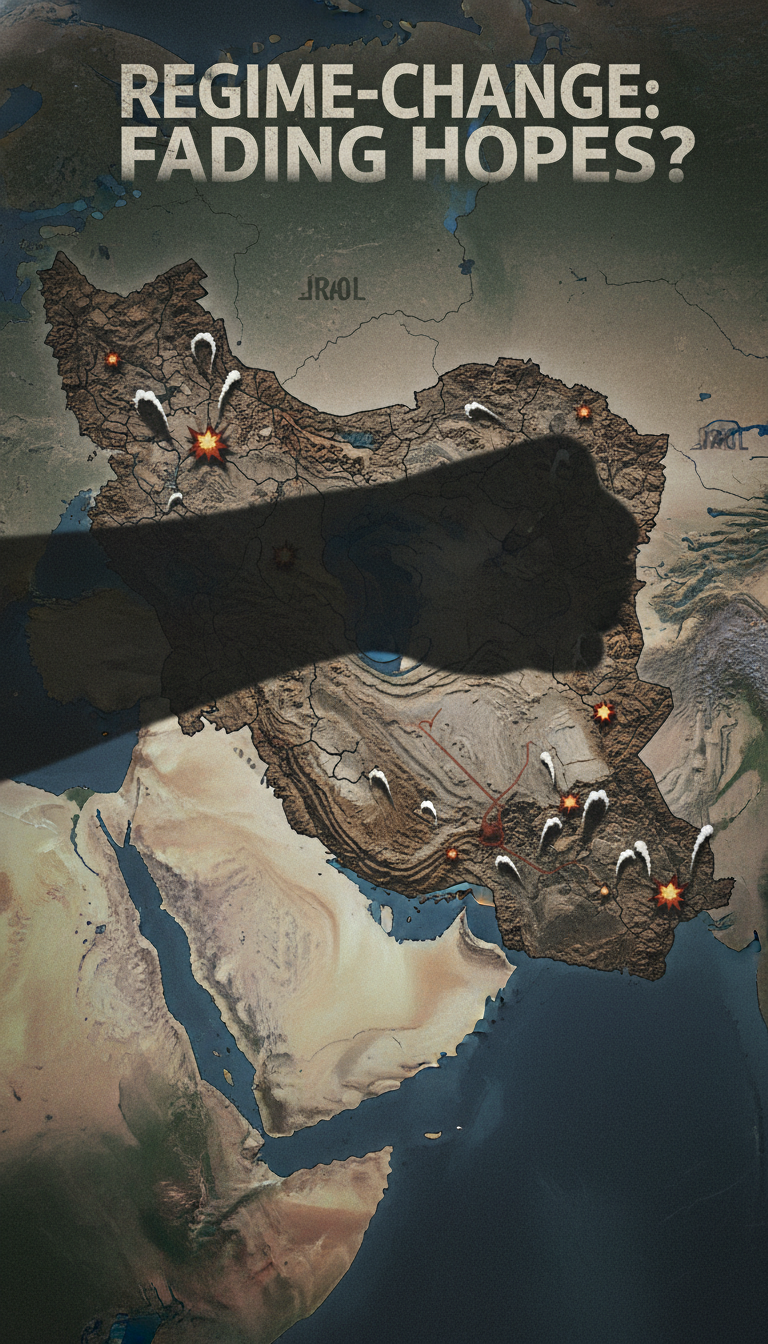
Trump’s latest message on Iran matters less for its tone than for what it leaves out. Earlier rhetoric hinted that military pressure might open the door to a popular uprising and even regime change. Now the emphasis appears narrower: the U.S. may be trying to damage Iran’s military and nuclear capacity enough that Washington can declare success and step back. That sounds simpler, but it raises two harder questions: what exactly counts as success, and how do you prevent Iran from rebuilding if you do not intend to occupy the country?

What changed in the U.S. objective?
The clearest shift is political and practical. A regime-change strategy requires assumptions that events have not supported: that sustained bombing would trigger mass revolt, that Iran’s leadership would fracture quickly, and that the U.S. could shape what came next without a major ground commitment. None of that has clearly happened.
Instead, the administration now appears to be moving toward a more limited objective: degrade, deter, and contain. In plain terms, that means damaging Iran’s ability to launch attacks, slowing any nuclear or missile recovery, and preserving the option to strike again if Tehran rebuilds. That is a very different mission from overthrowing the regime.
This also helps explain the contradiction between talk of “winding down” and reports of continued strikes and added Marines. A wind-down in this context likely does not mean peace or immediate de-escalation. It more likely means shifting from an intense opening campaign to a lower-burn posture built around deterrence, force protection, and selective follow-on attacks.
Why back away from regime change now?
Three pressures stand out.
- No visible uprising: Air power can weaken a state, but it rarely creates a stable political alternative on its own. Iran’s security apparatus may be damaged, yet still strong enough to suppress protests.
- Economic blowback: Oil around $112 a barrel and U.S. gasoline near $4 create domestic political pain. That makes an open-ended war harder to sustain.
- Strategic memory: Washington knows the Iraq lesson. Destroying capacity is one thing; owning the aftermath is another. If there is no appetite for occupation, officials have an incentive to redefine victory before events define failure for them.
That is why the omission of regime change is so important. It is not just a messaging tweak. It suggests the White House is aligning its public goal with the limits of what it is actually willing to do.
Explore our free history and politics courses
Political Theory I: Classical
University · Political Science

Political Theory II: Modern
University · Political Science

International Relations
University · Political Science
Comparative Politics
University · Political Science

Political Theories
Hobby course

International Relations
Hobby course
So what are the scaled-back objectives now?
If regime change is no longer the operative goal, the likely objectives are more concrete and measurable:
- Reduce Iran’s near-term strike capacity by hitting launch sites, command nodes, air defenses, and logistics.
- Set back nuclear and missile infrastructure enough to buy years, not permanent elimination.
- Secure maritime traffic, especially around the Strait of Hormuz, where disruption can spike global energy prices.
- Reestablish deterrence by signaling that rebuilding key capabilities will trigger renewed attacks.
Notice what is missing: democratic transition, national reconstruction, or a post-regime political roadmap. That absence is revealing. It means the mission is becoming less about transforming Iran and more about managing risk from the outside.
How can the U.S. stop Iran from rebuilding without occupation?
This is the deepest problem, because military strikes can destroy facilities faster than they can control what follows. Without ground forces, the U.S. has only a handful of tools:
- Persistent surveillance to detect reconstruction of missile, drone, or nuclear-related sites.
- Repeat strikes against any visible rebuilding effort.
- Naval and air pressure to limit movement of sensitive materials and protect shipping lanes.
- Economic leverage, including sanctions or selective waivers, to shape oil markets while pressuring Iran’s recovery.
- Regional partnerships for basing, intelligence, and interception, even if allies avoid direct combat roles.
But this model has a built-in weakness: it is a containment strategy, not a final settlement. Iran does not need to rebuild openly or quickly. It can disperse assets, harden facilities, rely on proxies, and wait for political attention to drift. In other words, the U.S. can make rebuilding harder and slower, but not guarantee that it never happens.
The likely real promise behind “winding down” is not “the problem is solved.” It is “we think we can manage the problem at a lower cost than full-scale war.”
What should we watch next?
The key indicators are not speeches alone but behavior:
- Do strikes narrow to occasional enforcement rather than broad campaign tempo?
- Are incoming Marines used mainly for regional defense and evacuation support, or as part of escalation planning?
- Does Washington define specific red lines for Iranian rebuilding?
- Do oil-market interventions continue, suggesting economic pressure is shaping military decisions?
If those signs point toward containment, then Trump’s post will look less like a peace signal than a reframing of victory.

Conclusion
The most plausible answer is that the U.S. is retreating from an unworkable regime-change idea and replacing it with a narrower goal: leave Iran weaker, deter rebuilding, and avoid occupation. That may be more realistic, but it is also less decisive. The central tension remains unresolved: America can damage Iran from the air, yet preventing recovery without owning the aftermath is far harder. That is why “winding down” may mark not the end of the conflict, but the start of a long containment phase.


