

Physics
Mar 26, 2026
Classical Mechanics
Electromagnetism
Quantum Mechanics
Thermodynamics
Statistical Mechanics
Astrophysics
How Japan’s Earthquake Alerts Really Work — and Why They Only Buy You Seconds
Japan’s Earthquake Early Warning system can send alerts seconds before shaking arrives, and viral videos make it look almost supernatural. Here’s the physics behind those precious
Japan’s earthquake alerts can feel uncanny: a phone screams, a livestream host freezes, and then the room starts shaking. The deeper truth is even more interesting. These warnings are not predicting the future. They are exploiting a tiny gap built into the physics of earthquakes — and that gap is both powerful and brutally limited.

That is why the viral clips matter. They show a real system working in real time, often giving people just 3 to 10 seconds. For trains, factories, and surgeons, those seconds can matter enormously. But for a giant offshore quake near populated coasts, the same physics that makes the system possible also sets hard limits on how much warning anyone can get.
The key physics: fast waves first, damaging waves later
When a fault ruptures, it sends out different kinds of seismic waves. P-waves are compressional waves that usually travel around 6 to 8 km/s. They tend to arrive first and often cause weaker shaking. S-waves move more slowly, roughly 3 to 4 km/s, and usually bring the stronger side-to-side motion that does more damage.
Earthquake Early Warning, or EEW, works because instruments near the epicenter can detect the first P-waves, estimate that an earthquake is underway, and send alerts electronically before the slower, stronger S-waves reach places farther away. In other words, the warning is racing against the shaking — and electronic communication usually wins.
Explore our free physics courses
Classical Mechanics
University · Physics
Electromagnetism
University · Physics
Quantum Mechanics
University · Physics
Thermodynamics
University · Physics

Statistical Mechanics
University · Physics

Astrophysics: From Stars to Galaxies
Free course
Why the warning is sometimes only a few seconds
The size of the warning window depends mostly on distance. If you are close to the rupture, the S-waves may arrive almost immediately after the P-waves. That means there may be little or no useful public warning. If you are farther away, the gap grows, and the system may buy several seconds or, in some cases, tens of seconds.
This is why livestream clips often show short lead times rather than long countdowns. A 3-to-10-second warning is not a failure; it is often exactly what the physics allows. Japan’s upgraded systems can give some Shinkansen trains around 20 seconds in favorable cases, which is enough to trigger automatic braking even if it is not enough for people to evacuate.
The biggest misconception is that EEW “predicts” earthquakes before they start. It does not. The rupture has already begun. The system is detecting the first evidence and calculating fast.
How Japan avoids too many false alarms while staying fast
Japan’s reliability comes from dense instrumentation and layered decision rules. The country uses thousands of seismometers and strong-motion sensors, run mainly by the Japan Meteorological Agency and research networks. A single odd signal is not enough. The system compares readings across multiple stations, checks whether the timing fits a real wavefront, and rapidly updates the estimated location and magnitude as more data arrive.
That matters during earthquake swarms, when many small events can confuse simple systems. The challenge is balancing speed against confidence: alert too early and you risk false alarms; wait too long and the warning loses value. Modern EEW systems use progressively refined estimates, which is why an alert may be updated after the first notification.
The hardest case: a close-in Nankai Trough megaquake
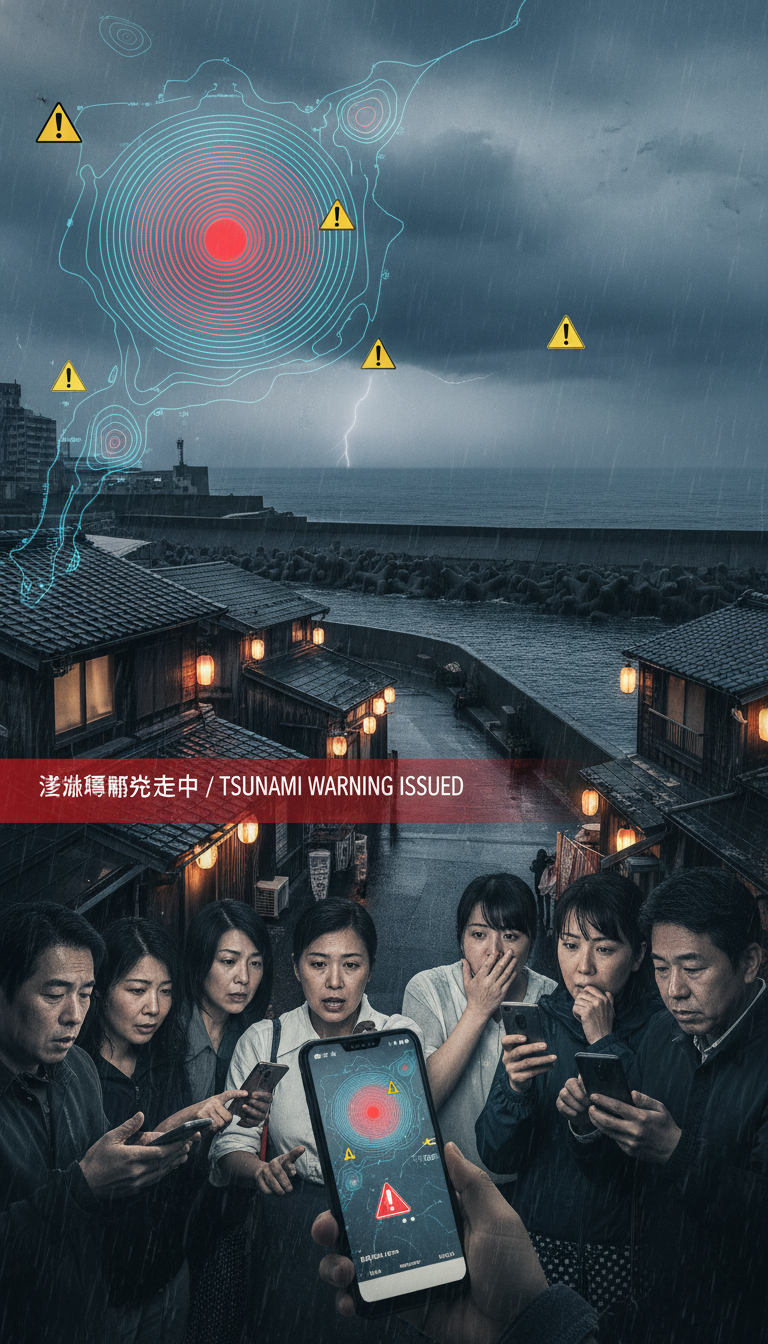
This is the question behind much of the public anxiety. For a major Nankai Trough earthquake, EEW would still work in the technical sense: sensors would detect the rupture and alerts would go out. But effectiveness would vary sharply by location.
Areas very close to where rupture begins could get little warning because the destructive waves would arrive too quickly. Cities farther from the first rupture zone could still gain valuable seconds. For infrastructure, that can be lifesaving:
- trains can brake automatically,
- elevators can stop at floors,
- gas lines and industrial systems can shut down,
- people can move away from shelves, glass, or hazardous equipment.
So EEW is not useless in a megaquake. But it is not a shield. Its value is highest when paired with building codes, drills, tsunami planning, and automatic safety systems.
Why other countries struggle to match Japan
The idea is exportable, but the performance depends on geography, sensor density, communications, and public trust. Japan has unusually strong incentives: frequent earthquakes, heavy investment, and a population trained to react quickly. Other countries may have the physics, but not yet the same network coverage or integration with rail, industry, and phones.
That is the real lesson from the viral videos. The impressive part is not just that an alert arrives before shaking. It is that an entire national system has been built to turn a few seconds of physics into practical action.
Bottom line
Japan’s earthquake alerts work because P-waves outrun the more damaging S-waves, giving sensors a narrow chance to warn everyone else. They do not predict quakes in advance, and they cannot create time where physics leaves none. In a close offshore megaquake, some places may get only moments or less — but those moments can still reduce injuries, slow trains, and trigger protective systems. The miracle is not prediction. It is speed, engineering, and preparation.