


Physics
Mar 26, 2026
Classical Mechanics
Electromagnetism
Quantum Mechanics
Thermodynamics
Statistical Mechanics
Astrophysics
CERN Put Antimatter on a Truck. Why That Tiny Cargo Could Matter Enormously
CERN’s BASE team transported 92 antiprotons in a portable Penning trap without losing a single particle. Here’s how a 1-ton device kept antimatter alive on the road, why this is no
CERN’s antimatter truck test sounds like science fiction: 92 antiprotons, carried in a vehicle, survived a real drive. The deeper story is not about danger but control. Moving antimatter is hard for the same reason it is scientifically valuable: if you want to compare matter and antimatter with extreme precision, you must isolate a few particles from almost everything—heat, gas, vibration, electrical noise, and ordinary matter itself.
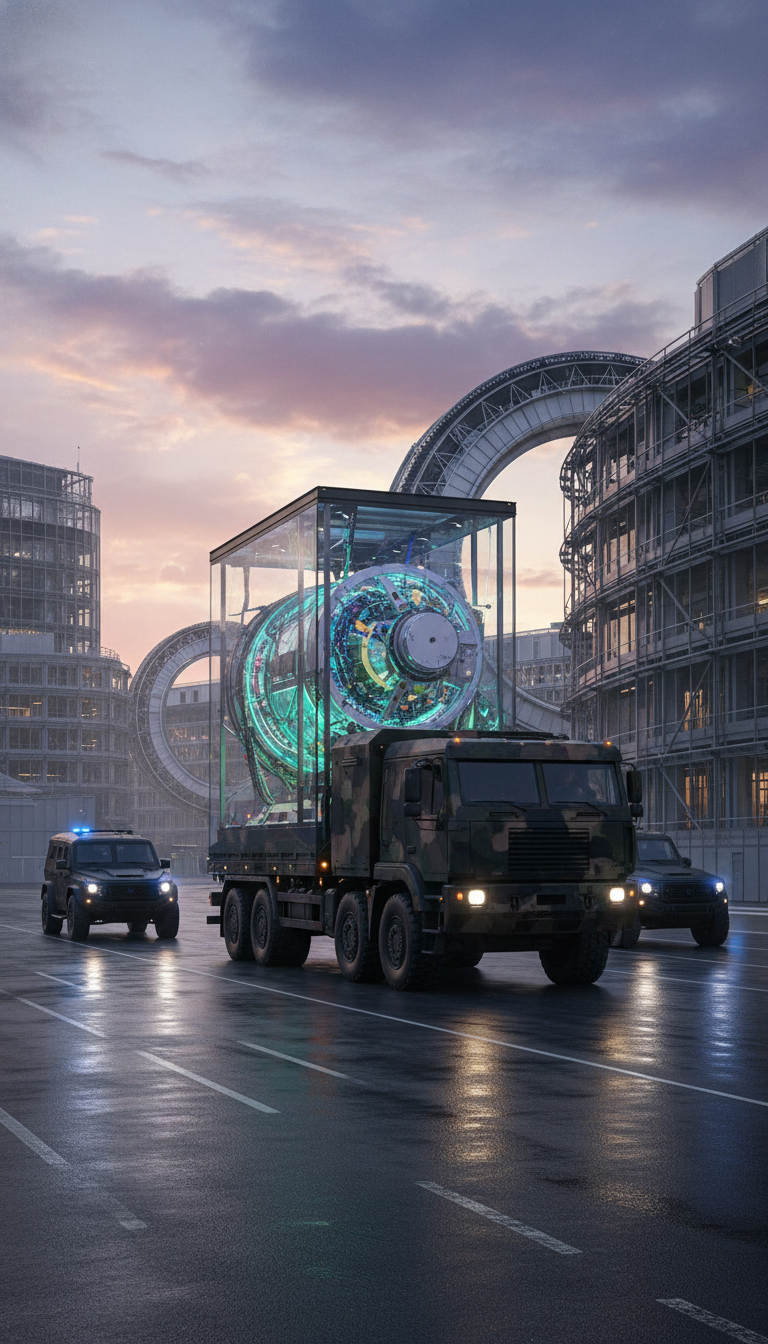
That is why the headline number is not just “92 antiprotons,” but also “1-ton portable trap.” The breakthrough is less about quantity than about proving a new capability: antimatter no longer has to be studied only where it is produced.
What CERN actually did
On March 24, 2026, the BASE collaboration transported antiprotons in a portable cryogenic Penning trap around the CERN site for roughly 20 to 30 minutes over a loop of several kilometers. The particles were loaded from CERN’s Antimatter Factory, disconnected, driven by truck, then reconnected and checked. All 92 survived.
This was a validation test, not a highway shipment across Europe and not a transport of bulk antimatter. CERN did not move antihydrogen bottles or anything remotely weaponizable. It moved a tiny number of charged antiparticles held in an electromagnetic trap under extreme laboratory conditions.
How can antimatter survive a truck ride?
Antiprotons annihilate if they touch ordinary matter, so they must never touch the walls of their container. A Penning trap solves this by using magnetic fields to confine charged particles sideways and electric fields to confine them along the trap axis. In effect, the particles float in vacuum, suspended by fields rather than stored in a material box.
Explore our free physics courses
Classical Mechanics
University · Physics

Electromagnetism
University · Physics
Quantum Mechanics
University · Physics

Thermodynamics
University · Physics

Statistical Mechanics
University · Physics

Astrophysics: From Stars to Galaxies
Free course
But that only works if the environment stays extraordinarily stable. The portable system therefore combines several demanding technologies:
- Ultra-high vacuum, so the antiprotons do not collide with stray gas molecules.
- Cryogenic temperatures below about 8 K, which reduce noise and help the superconducting magnet operate.
- A superconducting magnet, providing the strong, steady field needed for confinement.
- Mechanical and electrical robustness, so bumps, disconnects, and reconnection do not kick the particles out of the trap.
That is why a system built to carry just 92 particles can still weigh over a ton. The mass is not the cargo; it is the life-support system.
Why this is not an antimatter bomb
One viral misconception is that “CERN drove a bomb around Geneva.” That is false. Ninety-two antiprotons have an almost absurdly tiny mass—around 10-23 grams. If they annihilated, the released energy would be negligible on human scales.
The real challenge is not containing a huge amount of energy. It is preserving a vanishingly small, exquisitely controlled sample long enough to measure it. In other words, this is closer to transporting the world’s most delicate clock than to transporting fuel.
Why physicists care: precision tests of matter versus antimatter
The scientific payoff is potentially much bigger than the transport demo itself. CERN is the world’s only source of low-energy antiprotons, but CERN is not the quietest possible place to make every precision measurement. Large accelerator infrastructure creates magnetic and electrical disturbances that can limit sensitivity.

If antiprotons can be shipped to quieter laboratories such as Heinrich Heine University Düsseldorf, researchers may be able to measure properties like the antiproton magnetic moment with much higher precision. Those results can be compared with the proton’s properties.
According to CPT symmetry, matter and antimatter should match in key properties except for sign reversals such as charge. If a proton and antiproton differ in a deeper way, that would be revolutionary physics. It would not by itself solve the universe’s matter-antimatter imbalance, but it would point to cracks in one of the most fundamental symmetries in modern theory.
What happens next?
The two big open questions are practical and scientific.
- Can the trap keep antiprotons alive for much longer trips? A 20- to 30-minute CERN loop is a major first step, but an 8-hour journey to another country is harder. Power stability, cryocooler performance, road vibration, and recovery after transport all become more demanding.
- Will off-site labs actually deliver dramatically better measurements? That is the whole point of transport. If quieter environments produce the expected precision gains, antimatter research could become more distributed instead of being bottlenecked at CERN.
There is also a broader implication: once transport is reliable, scientists can start asking whether more particles, longer routes, or even other antimatter systems might eventually be moved.

The real significance
CERN did not put dangerous amounts of antimatter on the road. It proved something subtler and arguably more important: antimatter can be treated as a transportable scientific sample. That changes the geography of the field.
So the achievement is not that 92 antiprotons survived a truck ride. It is that precision antimatter physics may no longer have to happen only where antimatter is born. And if that leads to sharper tests of proton–antiproton equality, this humble road test could become the moment antimatter research truly left the factory.