

math
Mar 20, 2026
Why the 2026 Vernal Equinox Isn’t Actually Equal Day and Night
The spring equinox arrives on March 20, 2026 at 14:46 UTC, but the most interesting math is not the date itself. It’s why an event famous for “equal day and night” usually does not
On March 20, 2026 at 14:46 UTC, the Sun crosses the celestial equator and astronomical spring begins in the Northern Hemisphere. That sounds simple. But the deeper layer is this: the equinox is defined by a precise geometric crossing in space, not by equal daylight on your clock. Once you separate those two ideas, the math becomes much more interesting.

What the equinox actually is
The vernal equinox happens when the Sun’s apparent path on the sky, the ecliptic, crosses the celestial equator heading north. This is a consequence of Earth’s axial tilt, about 23.44 degrees, relative to its orbit around the Sun.
At that instant, the Sun’s declination is 0 degrees. In plain language, it is directly above Earth’s equator at local noon. That is the true astronomical definition. It does not mean every place on Earth gets exactly 12 hours of daylight and 12 hours of darkness that day.
This is why the exact timestamp matters: 14:46 UTC marks a geometric event, not a whole-day average.
Why the Sun rises due east and sets due west
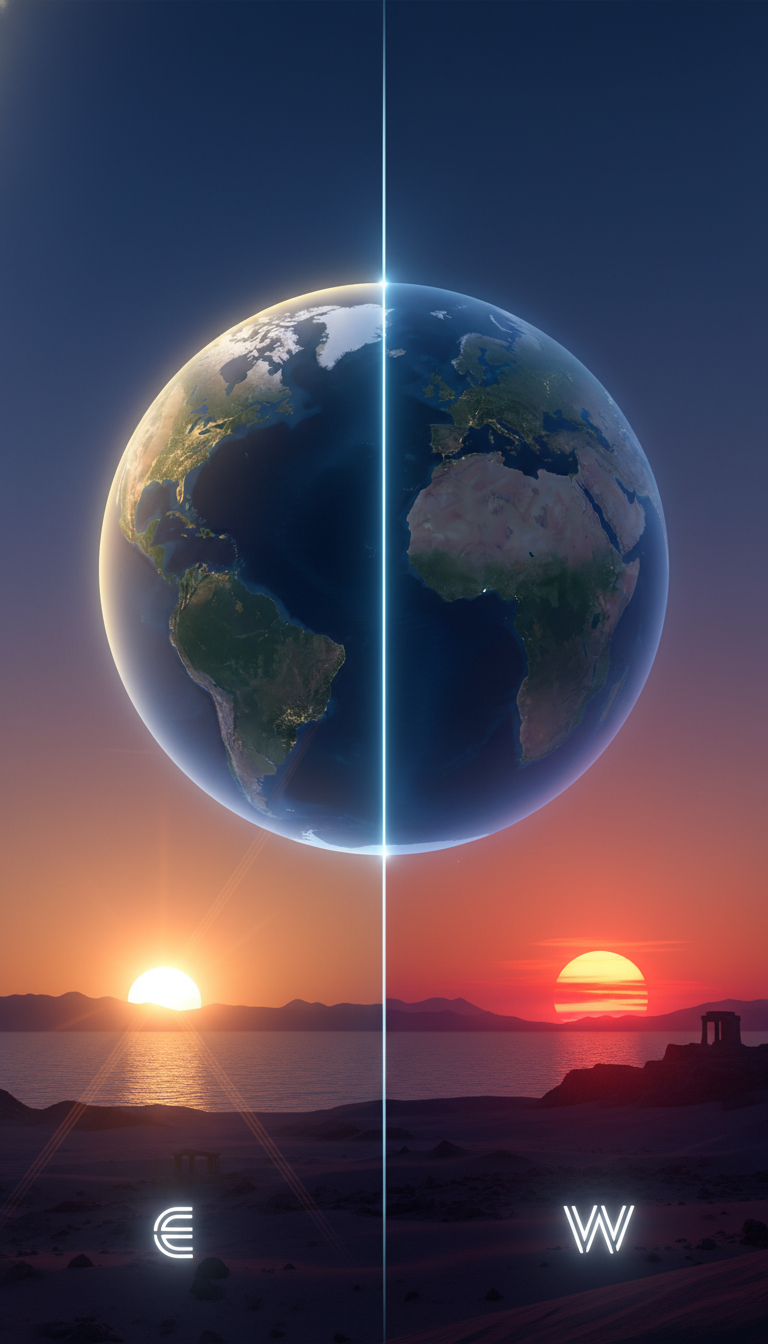
One beautiful equinox fact is nearly true everywhere outside the poles: sunrise is due east and sunset is due west. The reason is geometric.
When the Sun’s declination is 0 degrees, it lies on the celestial equator. The celestial equator intersects the horizon at the east and west points. So as Earth rotates, the Sun crosses the horizon exactly at those azimuths.
That north-south alignment of the day-night boundary, called the terminator, is another consequence of the same geometry. On an equinox, the dividing line between day and night runs almost pole to pole.
Why day and night are not exactly equal
This is the most common misconception. If sunrise were defined by the Sun’s center crossing a perfectly sharp horizon in a world with no atmosphere, then equinox day length would be 12 hours almost everywhere. But real observations use a different standard.
Sunrise is recorded when the upper edge of the Sun appears on the horizon, not when its center does. Two corrections matter:
- The Sun has angular size: its disk is about 0.5 degrees wide, so the top appears before the center reaches the horizon.
- Atmospheric refraction: Earth’s atmosphere bends light upward, making the Sun appear higher than it really is near the horizon.
Together these effects amount to about 0.83 degrees. That means you see sunrise a little early and sunset a little late, stretching daylight beyond 12 hours. The exact amount depends on latitude and local conditions, but the effect is real almost everywhere.
That is why equilux, the date with exactly 12 hours of daylight and 12 hours of darkness, usually happens a few days before or after the equinox instead.
The math behind daylight length
A standard approximation for daylight duration is based on latitude φ and solar declination δ. At equinox, δ = 0, which makes the idealized answer 12 hours. More generally, spherical astronomy gives a sunrise hour angle that leads to formulas of the form:
daylight ≈ 12 + (24/π) × arcsin(tan(φ) × tan(ε))
where ε is Earth’s obliquity in simplified seasonal models. For the exact equinox, the clean geometric result is 12 hours only in the ideal case. To match observed sunrise and sunset, you must include the horizon correction of roughly -0.83 degrees in the altitude condition. That small-looking angle is enough to break the “perfect balance” story.

Why the date changes from year to year
Another myth is that the spring equinox always falls on March 21. In fact, it can occur on March 19, 20, or 21 depending on time zone and century.
The reason is that Earth does not orbit the Sun in exactly 365.000 days. The tropical year is about 365.2422 days, so our calendar uses leap years to stay aligned. But leap-year rules are only an approximation, and Earth’s orbit is slightly elliptical. Add precession, nutation, and other small perturbations, and the equinox time shifts from year to year.
That is why 2026 lands on March 20 at 14:46 UTC, and why future equinoxes will continue to drift within a narrow range.
Why this mattered historically, and still does
Equinox geometry is not just a calendar curiosity. It helped humans measure the planet itself. Ancient astronomers used shadow lengths and solar angles near equinox conditions to reason about Earth’s size and curvature. The famous tradition associated with Eratosthenes showed that careful geometry on a tilted, rotating Earth could reveal global facts from local measurements.
Today, the same mathematics scales up to precision ephemerides. Modern equinox times are computed with models that include orbital eccentricity, gravitational perturbations, aberration, and nutation. The headline timestamp looks neat, but behind it is centuries of increasingly refined math.
Conclusion
The 2026 vernal equinox is a precise moment when the Sun crosses the celestial equator, not a guarantee of perfectly equal day and night. Its real beauty is mathematical: a tilted axis, a spherical horizon, a refracting atmosphere, and a calendar trying to keep up with an orbit that is never perfectly simple. The equinox is famous for balance, but the truth is more subtle—and more elegant.